
Five things I learnt while making Glasgow: Satellite City
Over the past two decades, Glasgow has become Europe's leading producer of small satellites. This little-known fact was the starting point for our BBC Radio 4 science programme, ‘Glasgow: Satellite City’, in which BBC technology journalist Shiona McCallum explores this undersung manufacturing success story. The programme was produced by me, Katie Revell, and executive produced by Carys Wall.
Here are five things I learnt while making the programme:
- Glasgow has a major satellite industry
This in itself was news to me! I’ve lived in Glasgow for nearly 10 years, but had no idea that the city is a hub for small satellite manufacturing (and other space sector businesses). In 2005, Glaswegian engineer Craig Clark established Clyde Space (now AAC Clyde Space), which specialises in designing and building CubeSats – more on those below. In the years since, other businesses have set up shop here, creating satellites, building rockets, and analysing satellite data. The city’s universities also play an important role in training the next generation of space sector workers, and collaborating with the private sector on research and innovation.
- Scotland has a Space Envoy
And his name is Daniel Smith. He’s an entrepreneur who runs space communications firm AstroAgency. In his role as Space Envoy – as part of the Scottish Government’s international business network – he helps Scottish space sector businesses to establish partnerships and identify new opportunities.
- The satellites built here can be as small as a Rubik’s Cube
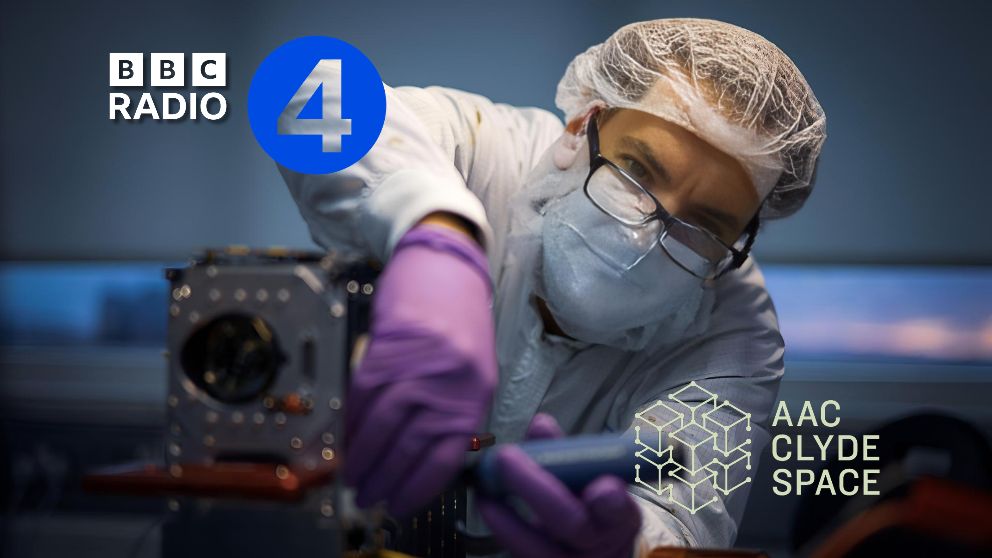
Picture a satellite. Are you thinking of something the size of a car, or even a bus? Well, Glasgow’s satellite manufacturers specialise in designing and building satellites that can be as small as a Rubik’s Cube. Called CubeSats, they’re created from modular components measuring just 10cm by 10cm by 10cm. These cubes can be stacked together to create larger structures to house whatever ‘payload’ is needed – such as cameras, sensors or communications technology.
- Satellite data can help communities defend their rights
Celia Davies runs Glasgow-based social enterprise Omanos Analytics, which specialises in combining non-commercial satellite data with other information to support sustainable development around the world. Celia told us about one case in Guinea, where a farming community had been displaced by a gold mining company. Omanos used satellite data to verify the community’s claims about how the displacement had affected their lives and livelihoods, helping support their – ultimately successful – compensation claim.
- Scotland is a pioneer in space sustainability – but there’s still a LOT of work to be done
The environmental impact of the space sector – here on the surface, in Earth’s atmosphere, and in orbit – is undeniable. From the manufacturing of satellites, satellite components and rockets, to the construction of launch infrastructure, to launch itself: every stage of the process has a significant environmental footprint. And once satellites reach the end of their useful lives, they risk becoming ‘space junk’ and endangering other satellites and spacecraft. In 2022, Scotland became the first country in the world to publish a Space Sustainability Roadmap, setting out a path to a more sustainable Scottish space sector. It’s progress – but there’s still a very long way to go before Scotland’s, let alone the world’s, space sector can be considered environmentally sustainable.
You can listen to Glasgow: Satellite City here: https://www.bbc.co.uk/programmes/m0030xh2
And read Shiona McCallum’s excellent BBC InDepth article expanding on the programme here: https://www.bbc.co.uk/news/articles/cm2kedyp348lo
Glasgow: Satellite City was produced by Katie Revell, presented by Shiona McCallum, executive produced by Carys Wall, and mixed by Joel Cox. Thanks also to Patrick Wallace who came up with the idea!